Spore
Though atomically a simple game, across the entire experience Spore is dreadfully complicated. It succeeds in making some higher gaming functions accessible to non-gamers, just as The Sims did before it. And it succeeds in demonstrating some absolutely awesome technology that shows real promise for the future of the entire industry. But it is also held together by a hodgepodge of poor game design and implementation. Though the reviewing masses don't hesitate to point out particular points of interest and praise, it's hard to deny that, in general, Spore is unimpressive on the "fun" scale.
As a human who can both read and use the Internet, by now you know that Spore has five stages. Throughout the course of the game, a species you create and cultivate grows from paramecium to galactic conqueror, with you the player as the Intelligent Designer. This may make you think that each of the five stages is intimately tied to the others; but, in truth, the relationship is vague, and each stage is extremely unique (though the third and fourth are conceptually similar, and the fifth includes part of the fourth as a sort of side-feature). Let me break it down.
Cell - you're a microorganism competing for food in the primordial soup of your new home planet. What you eat is decided by your mouth (herbivorous/carnivorous/omnivorous), which you choose along with other features of your little microbe. At this stage of the game, the design features are extremely limited, as you have to stretch your scant DNA Points between key abilities like movement, defense, and offense. As you consume, you grow, making the last moment's competing organisms into this moment's lunch meat.
It's been likened to simple action/arcade games, but the Cell stage is really just half an hour of poorly designed gameplay. You don't move in a straight line, which makes it look more "realistic" but also a pain in the ass to actually get to the food/creature you want to eat. Combat couldn't be less interesting, as your natural armaments mean you will either kill an underpowered creature, or be killed by an overpowered one. But none of that matters because if you die you simply respawn instantly. It's fun for maybe a minute, and then it's just a treadmill of consumption and evasion/death until you become large enough for stage 2.
Creature - like a third-person action-RPG, but with a complete lack of abilities and a confusing world full of unintelligent creatures you don't care about. Ally with neighboring nests, or just fucking eat them. Combat is like World of Warcraft if you only had four buttons. Befriending other creatures is like World of Warcraft if you had four "/dance" buttons.
The best part of this stage is the design, because you can actually make a cool creature, and in this stage you really get a reasonable amount of points to balance between your abilities. Do you want to glide? Get wings! Want to eat people? Put buzzsaws on your arms! This is where the creature creator part of the game shines. The stage is a short hour or two until you develop enough to become sentient, but a lot of it still feels like filler, as you traverse the continent to find more dudes to dance with or fuck up.
Tribal - an abysmal attempt at real-time strategy, the Tribal stage is probably the weakest of the five, even more so than Cell simply because this one really drags on. Here your creature has grown its basic communication skills and learned to use tools, and so your species has formed a tribe that can hunt for food, and manipulate other tribes through gifts or outright violence. At this point the design features are significantly pared down, and you can only customize the clothing of your creature, which can affect its hunting, gathering, and socializing aptitudes. But with the options as they are, it really just boils down to a Pick The Best Item minigame.
There is a primitive implementation of resource management in the form of food; you create new tribe members with it, you sustain current tribe members with it, and you build new tribe huts with it (like an axe shop, or a wooden flute shop, or a burning torch shop). There are five other tribes on the map, which you can ally with by being nice and playing music, or utterly destroy by attacking their home camp with your guys. The lack of features from previous phases stays consistent here, so the enhanced length of this stage - until you deal with all five of your neighbors - just makes it more drudgery.
Civilization - also like an RTS, but way more fleshed out than Tribal, in the Civ stage you control a city and use Spice as currency. Build land and sea units to gain control of spice plumes, and build up your home city to increase the productivity/happiness of your citizens, and defend it against invaders. Send your units to other cities to befriend them, or brainwash them with religious propaganda, or conquer them with an iron fist. Eventually you also earn the ability to gain air superiority, along with other useful special abilities; once your foes are all but vanished, this culminates in an ICBM strike that leaves you as the sole owner of your home planet.
While this stage comes extremely close to resembling a real game, it still lacks the depth and features to give it enough legs for its duration. This is also where you'll learn to hate the designer, as you have to make your city's City Hall building, your House template, an Entertainment center, and a Factory, as well as Land, Sea, and Air units. I had fun with it at first, but by the last building I didn't give two shits what it looked like (since the design here is purely cosmetic), and even with units, the editor has a negligible effect on utility; your thing's offense, defense, and mobility are scored only in a ratio to one another, which rebalances based on the parts you add to the unit, e.g. more guns means higher offense but lower everything else. And I had such high hopes for my Star Destroyer.
Space - holy fuck. Design a spaceship - urgh. Then learn how to fly - boring. Then take off into space. Wow! The Space stage is a real, actual, honest-to-Grox game. Would you believe it? I actually had some fun here. No fuckin' way.
In the Space stage, your conquest must spread across the cosmos. The name of the game here is zooming; use your mouse wheel to zoom into a planet, where you can micromanage the ecology and economy by abducting or adding to the plant/animal life, and by further editing the building layout in each of your colonies. Zoom out and you can see your star system, and fly to other planets if you care to, though there's usually only one planet of interest per system. Zoom out further, and you can fly to nearby systems to exert your will on alien races.
As the game goes on - again, fairly slowly, but this time with some motivation to proceed - you earn new abilities, like more health and energy (for using tools and traveling), a better hyperspace drive, more and more powerful weapons, "socialization" tools (manipulating other races), and one of the neatest features of the stage, terraforming tools. Planets tend to not be hospitable by default, and so you'll need to use atmospheric and temperature manipulation to create a usable environment. Then populate the planet with imported plant and animal life to stabilize the "terrascore" and you can be well on your way to colonizing a new world. Though it does take a while, it is very cool and satisfying, in some ways even more so than blowing up a planet.
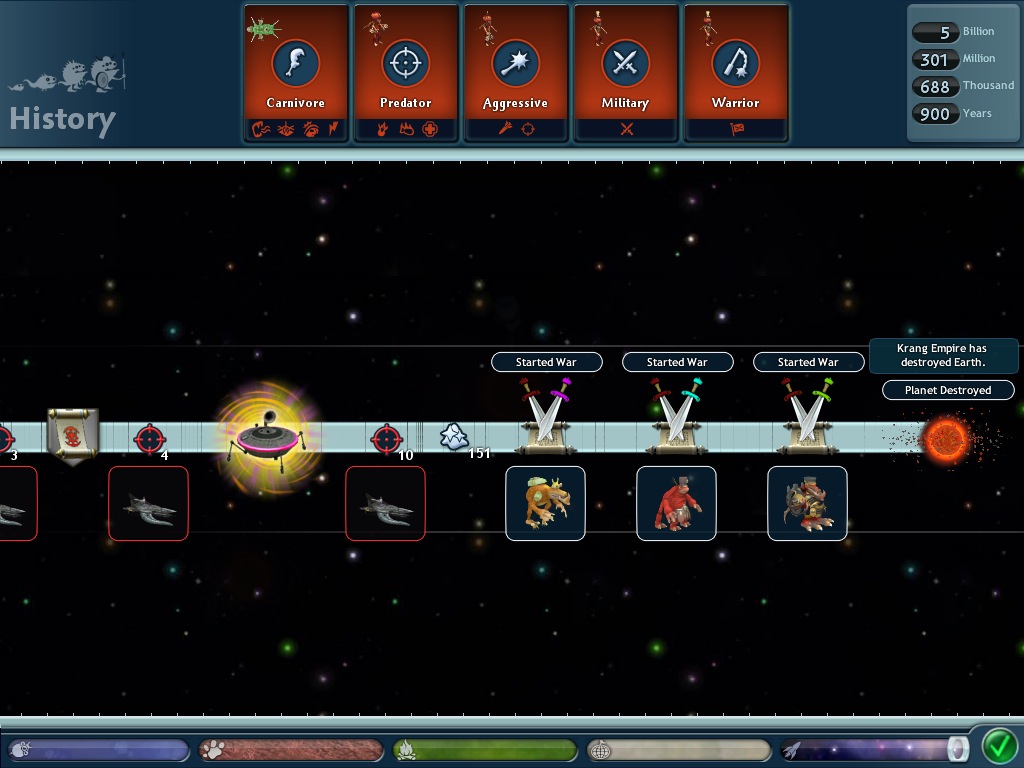
The stratifications of the Civ stage are continued here, with cultures varying from warlike to religious to economic. You can conquer other systems by force, or through religious conversion, or even by engaging in trade and buying a system outright. At the same time, your fellow galactic travelers may want to trade with you, convert you, or destroy you. And the galaxy is filled of literally countless stars, such that you could encounter new races until the end of time itself.
Unfortunately the end of time is still pretty far away, and for all its interesting features, the Space stage also suffers from the longevity issues of its preceding stages. After a while, missions get boring. Then learning how to be friends with aliens gets boring. Then blowing up all their colonies gets boring. Then jumping to random systems and following infinite wormholes gets boring. Though it has badges you can earn for completing numbers of varied tasks, the stage, and hence the game, lacks an ending. With the sheer size of the galaxy, there's absolutely no way you can conquer, or even see, the whole thing. It's similarly unreasonable to expect to defeat the evil Grox empire, as they ruthlessly possess hundreds, possibly thousands, of planets.
If anything could be said to be the stage's "goal," it would be getting to the Galactic Core, which is an enormous pain in the ass as it is surrounded by the aforementioned evil empire (such that, even with all possible ship upgrades, it isn't surprising to get toasted by attempting to take even one or two of their hundreds of systems from them). Also, "near the center of the galaxy, your interstellar drive's range is drastically reduced." Thanks, artificial difficulty! Asshole. Anyway, when you finally get fed up with doing it the right way and just stock on up health packs and bolt for the galactic center, you're rewarded with a short mildly-amusing cutscene and an item (with 42 limited uses) that can fully terraform and populate a planet. Great. It's fun for a while, but Space is ultimately not very satisfying.
The intended "link" between each of the five stages is carrying over assets from one into the next - your creature from stage 1 is used as a base for stage 2, though you have the freedom to change it completely if you wish. Similarly stage 3 has you putting clothes on your stage 2 dudes, and by the start of stage 4 you've designed the fully-equipped creature that will subjugate star systems. As each stage tracks your natural predilections - what you eat, who you eat, if you're willing to not eat them, et al - this tendency (along with some oft-unused special abilities associated with it) is also carried over, though it, too, can be changed at will. There is supposedly some replay value in the ability to try again as a religious race, or a money-driven one, or a bloodthirsty one, but I dare you to have fun playing as anything except the decisive, vengeful warrior.
As you may know, Spore has an interesting feature in its not-really-online component. Other players can contribute their designed creatures, buildings and units to the Sporepedia, which may find their way into your own game. It is an interesting idea, although the diverse set of creations shipped with the game from Maxis is more than enough to ensure you won't see the same thing in two places except by statistical aberration (or unless you put it there). It also begs the question - what if you could play with other people? The first four stages of the game would probably be more frustrating with real competition, but in the Space phase, already full of hundreds of thousands of don't-care star systems, adding real people into the mix could only make the galaxy more interesting. Yes, it would present some new design challenges, but the game is already full of those.
The game as a whole looks very pretty; there's no shortage of graphical polish all throughout. It sounds great, too. I was actually super-impressed with the game's audio, as the music is mood-fitting and excellently procedurally composed, and the sound effects, though sometimes irritating, are more often amusing.
The real reason Spore is important is not because of the gameplay - if you could skip the first four stages altogether, you absolutely should. No, what I'm most impressed with, and what makes it really significant, is what drives the game behind the scenes. The creation tool, though often frustratingly pointless, has the capacity to be engrossing in the right circumstances. The content engine that creates and handles the creatures around you, and the worlds around you, is of a scope never before seen in any kind of entertainment. The intelligence of artificial players is not clever or crafty, but startlingly accomodating, as friends and rivals react in ways that can occasionally make you forget they're not real. And the coolest thing, if you ask me, is how the creature/unit engine figures out the points of movement and articulation in your designs. When you shape your cell-stage blob into an upright humanoid, you really see the magic of a bipedal species coming to life. Totally fucking badass.
Obligatory length comment - the first three stages took me a brief evening, and the fourth another one, but the Space stage lasted several days afterward. Though, I had become fed up with it a good day or two before I actually finished to satisfaction.
Is it worth $50 and your computer's soul? Maybe not - even the fairly-fun Space stage could have been done better. But despite the lack of depth in almost all of its gameplay, Spore can't help but set the world on fire. And though it may not deserve the sales, it does deserve the attention. Will Wright would be a war criminal if he didn't see to it that the tech behind Spore make it into a more sophisticated, cohesive product.
Progress: Omnipotent, found Galactic Core, blew up Earth