Playing A Game Devil May Cry PS2

Augh. I tried playing Devil May Cry last week, and I got two stages in before I got bored and put it down. The introductory cinematic made me feel like an idiot - Dante fires his dual-handguns at a motorcycle that was thrown at him by a chick in a leather vest - which would be fine if the gameplay was at least compelling, but it really isn't doing it for me. Totally mindless slashing and gun-firing. Today I tried stage 3, which put me up against some lava spider boss who completely destroyed me, and I really don't care enough to keep trying.

It's extremely possible that I just haven't gotten to the part of the game that's "fun" yet, and so I'll be coming back to this at some point, but for now I just don't see any merit in it. Which sucks, because I actually bought it in a three pack.

Progress: Gave Up -- Mission 3

Playing A Game Indigo Prophecy PS2

Unfortunately, what I had been dreading since the ominous introduction came true. Indigo Prophecy began as a psychological crime drama, but at some point, became wholesale science fiction. To be fair, it's reasonably good sci-fi; but it isn't the gritty, introspective story I was hoping it would be.

As the game went on, it also exposed more of its own production weaknesses. The whole "thing" about choosing what to say in dialog is that deciding what you get out of an NPC as a response is a matter of strategic choice, in trying to figure things out. But later, the story develops into something so complicated that this mechanism becomes more of a logical fallacy than a tool - choices you don't take leave certain pieces of information unexplained, but after-the-fact dialog assumes that you know it anyway. There is just too much going on for the dialog choices to keep up with.

I also grew disappointed with the story itself as it drew to a close, especially in the ending. Schlocky writing decisions made a lot of it feel trite and impersonal. Most of all, the sci-fi aspects of the story brought Indigo Prophecy crashing back down into the realm of "video game." Later scenes appear sloppily put together in order to hasten the completion of the game, at the expense of its dramatic effect.

I feel like mentioning that, while Indigo Prophecy has a lot of "choice" in it, the choices you make tend not to affect the big picture very much. Sometimes you can get an early game over, which is easy enough to recover from; and there are three distinct endings, though they don't really differ from each other too much. In fact, the significance of the bevy of choices in the game is more illusory than real. They act to give you, the player, a strong feeling that you're sincerely directing the actions of the game's characters. It's not about content, but about immersion, and it works very well.

I really admire what's been accomplished in Indigo Prophecy, and it's done a pretty good job of living up to its intents. The motion capture, for instance, is absolutely superb in crafting characters that move and behave in a believable way. The quality voice acting and dramatic music are very well-implemented. And in its earlier portions, the writing really makes it feel less like a game, and more like a traditional storytelling piece. This is a good thing.

I really hope that someday, someone can do a more complete job of it, because making a game that plays like a good TV show or movie or book - something that really draws the player into a serious world (as opposed to a caricatured one), and the emotions of its characters - is a fantastic goal, and Indigo Prophecy proves that it's possible.

Progress: Complete
Rating: Good

From the beginning, it looked like the plot might get a little ... weird, as it developed, but I'm happy to say that I feel like I'm being eased into it real nicely. The way the game has spent time to make me feel comfortable with the characters - aside from time spent on fleshing out the game's story - is really admirable. For the most part, anyway. (There was one scene where I played the main character as a kid, in a flashback, and it was clear that the dialog writers didn't know they were writing for children, because the diction and vocabulary was the same as the adult character.)

Again, I have to say that what I dislike most about the game is the "game" part of it. The two-stick Simon game it uses in most interactive situations works really well, but there are some sequences that are just too goddamn long. It's not hard to do, just distracting, and when it lasts for a few minutes just so I can play a few notes on a guitar, I feel like I've wasted my time. Moving the characters around is also becoming a major pain, as the control stick orientation is constantly getting messed up by the cinematic moving camera.

But the story is really compelling. I'm drawn to it in a way similar to Hotel Dusk, in that I tend not to jump on whenever I have a minute; rather, on a daily basis, I'll sit down and play out a few chapters. And while I'm not sure how much I'm actually affecting the larger story based on my dialog and action choices in the game, it does lend a great deal of personality to the story, making me feel more immersed in it.

Progress: 1/28, 9:27 AM

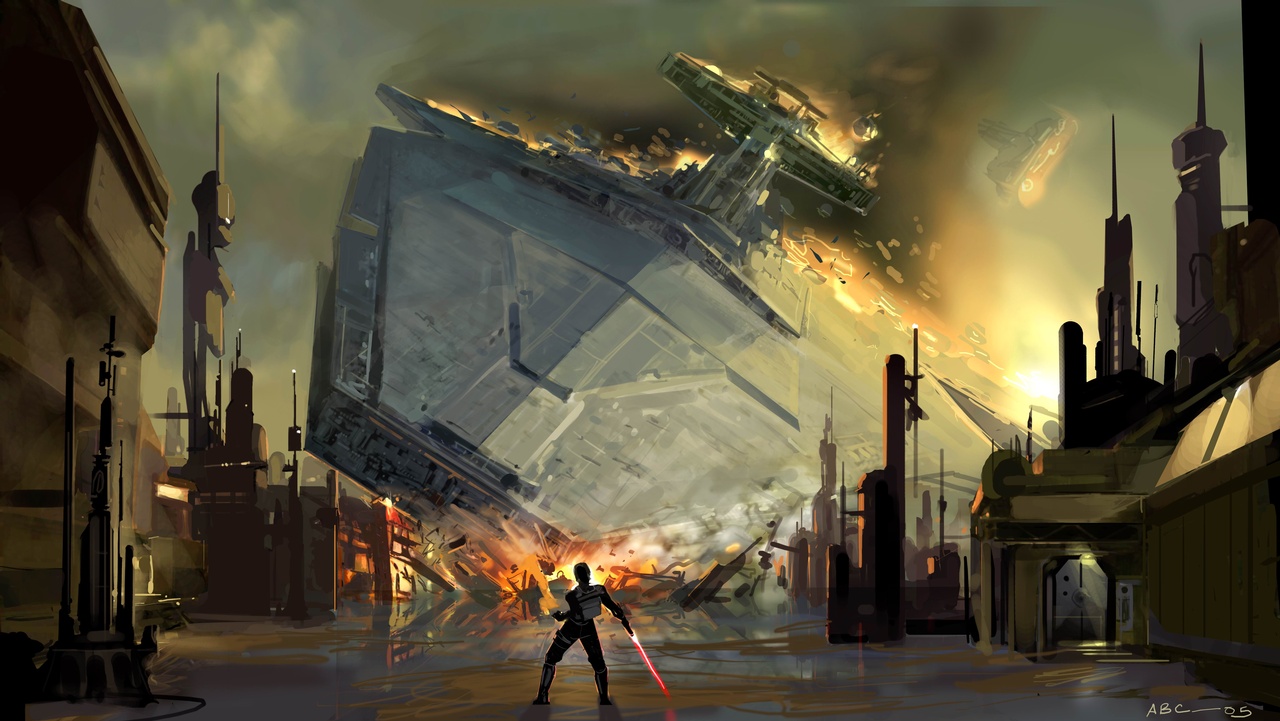
It's been a long time since I played a Star Wars game. I saw friends play Bounty Hunter; I saw friends play Jedi Knight II; and I wasn't too upset that I passed on them myself. I'm not about to argue with the guy who says that Lucasarts lost its touch after the point-and-click adventure titles (usually, that guy is me).

But for some reason, this one feels different. I mean there's the real-motion lightsaber swinging, but that only applies in a two-player battle mode. And they say that there's so much going on logistically - AI, physics, particle engines, everything interacting intrinsically - that it's a sort of magical hyperrealism; but we've all heard that song and dance before. I don't know, maybe it's just the fact that you can kill people with spaceships, but I've got a good feeling about this one.

I happened to be able to play the original Bangai-O a while back, and it's really an amazing game - controlled on two axes (ala Robotron), Bangai-O combines goofball Japanese themes and Treasure's infamous knack for high-octane shooters. When I heard they were making a new one for the DS (with wireless multiplayer! and a level editor!) I was beside myself. But! I recently learned that Spirits has removed the second axis; you can only fire in the direction you move. It may seem like a small change, but the two-axis dynamic was a key part of the old game, and now I'm a bit wary about this new one ... but I'll still give it a look.

Progress: Gave Up

I've read preview after preview of this game, and I'm still not totally sure how it works. What I am relatively sure of is that The World Ends with You has the most complicated battle system ever. I anticipate it hotly.

Progress: Back up to Chapter 6

Luigi's Mansion has all the traits and trappings of a bad game, and it would be wrong of me to call it anything else.

After the first area, the game becomes difficult by means of annoyance - trying to fend off multiple enemies at once is impossible; new rooms in the mansion take forever to get between; ghosts have to be followed once, twice, twenty times as they move from room to room and back again. My primary hardship with the final boss was because the boss himself obstructed my view, and I had no idea what the fuck was going on. The game is insultingly short at only a few hours, but to be honest I was still relieved to be done with the thing.

Not only is Luigi's Mansion missing polish, it's missing content. It's missing engagement. It's missing fun. Really, the only thing it does right is show off a new generation of graphical tricks, and trying to package it as a game was a mistake.

I feel for you, Luigi. I really do. Here's hoping you do better next time.

Progress: Complete

Rating: Awful

As I started this game, it was an affront to me. Everything about it - the weirdly-lit graphics, the quirky sound effects, the one-song "soundtrack," the invisible plot - just rubbed me the wrong way. It reminded me way too much of Vexx, which is just about the worst thing a video game can do.

As I'm getting further into it, the slightly increased depth of the game has me a little more interested. But its execution still irks me. Fortunately, I should be done with it very soon.

Progress: Area 2

Playing A Game Pikmin NGC

Something that struck me early on was Pikmin's difficulty - the game mechanics are sufficiently complex to have a hefty learning curve, and there is a tendency for it to exhibit Lemmings-esque frustration with the utter idiocy of Olimar's little worker-soldiers, especially as the enemies becomes more difficult and better able to demolish large numbers of pikmin at once. So, as far as games that I really like go, this one tends slightly toward the more annoying end of the spectrum. But it's challenging, which I admire.

The complexity of the game's puzzles never grows too great (which is good, because I had serious concerns about my time limit as I went through some levels). Pikmin's "game" lies not so much in planning, but in the player's ability to quickly and decisively react to threats, shifting goal priorities in real-time. This is something I'm historically no good at (I usually prefer to throw dozens of Scouts at my problems), but I still had fun working my way through Pikmin, and look forward to picking up Pikmin 2 (NGC) when I can find it.

Progress: 30 parts in 24 days

Rating: Good