Puzzles of the Rising Sun
After Opus Magnum: De Re Metallica's tiresome complexity and lackluster writing, Kaizen: A Factory Story is just what I needed.
It opens strong, with a bright, cute aesthetic and a keenly focused story. Set in the 1980s, midwestern business whiz David moves to Japan for a sales job, and immediately experiences the culture shock of Matsuzawa's onboarding process: putting him to work designing factory lines. David's mentor Ohyama-san encourages him to keep an open mind and shows him the ropes, as David tours - and helps build factories in - diverse segments of Matsuzawa manufacturing, from toys and home electronics to clothing and plastic display food.
Kaizen's dialog-driven story (including voice-acted interludes!) weaves in themes of traditional Japanese office culture, like strict managerial hierarchy, wa, and the salaryman stereotype; the economic boom and changing social norms of '80s Japan; American discomfort, and fascination, with that rising world power; the business value in a holistic understanding of production; even the virtue of trying new things outside one's comfort zone.
David's fish-out-of-water journey through each products' factories, meeting distinct and memorable personalities along the way, is an excellent narrative device for demonstrating those ideas through different perspectives.
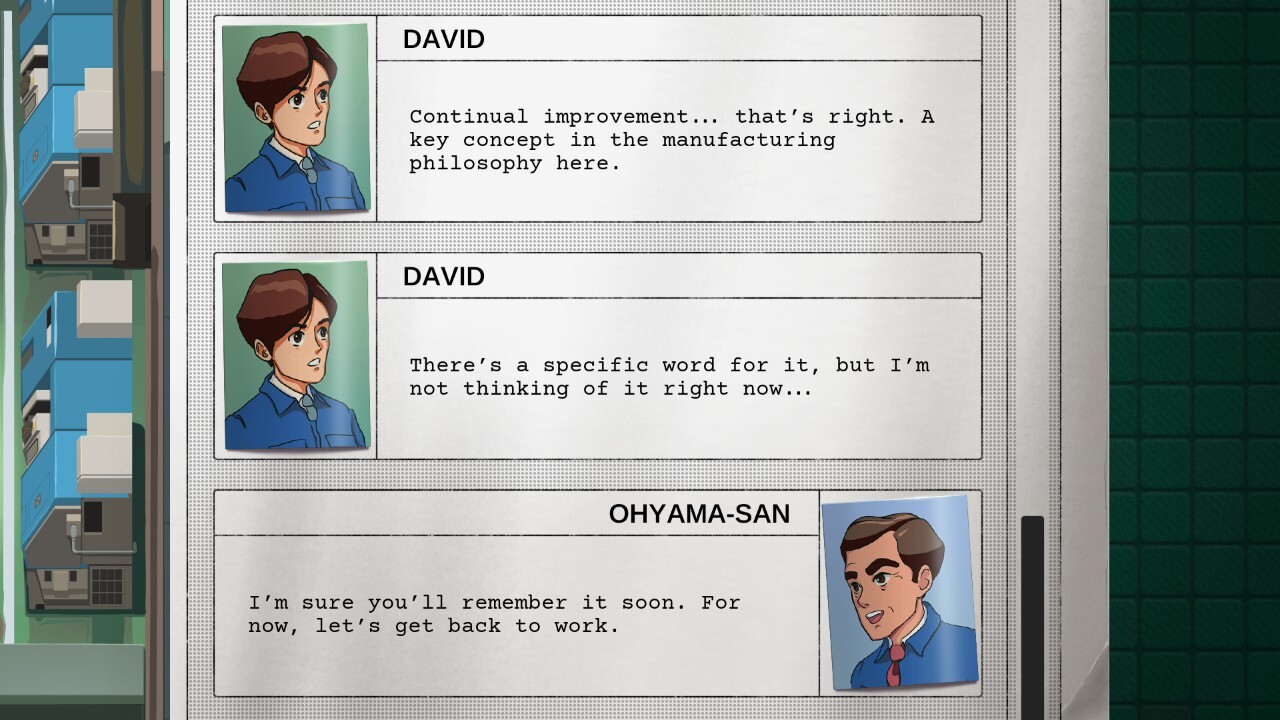
... well, for a while, anyway. I was a little let down that Kaizen runs out of new characters about halfway through, and neglects to follow up on most of the plot threads it had established earlier. Its culture and history themes aren't used so much as they are referenced or touched upon. The setting is still really charming, though, and a great stage for David's personal story.
Oh and there are puzzles!
Kaizen's automated-part-assembly puzzles have a similar spirit to Shenzhen I/O's device-making, but play a bit more like Opus Magnum's mechanical challenges. Each puzzle's goal is to assemble a product from existing parts: using arms to move and rotate them into place, welding and riveting them together, cutting off excess material (or cutting through templates) when necessary.
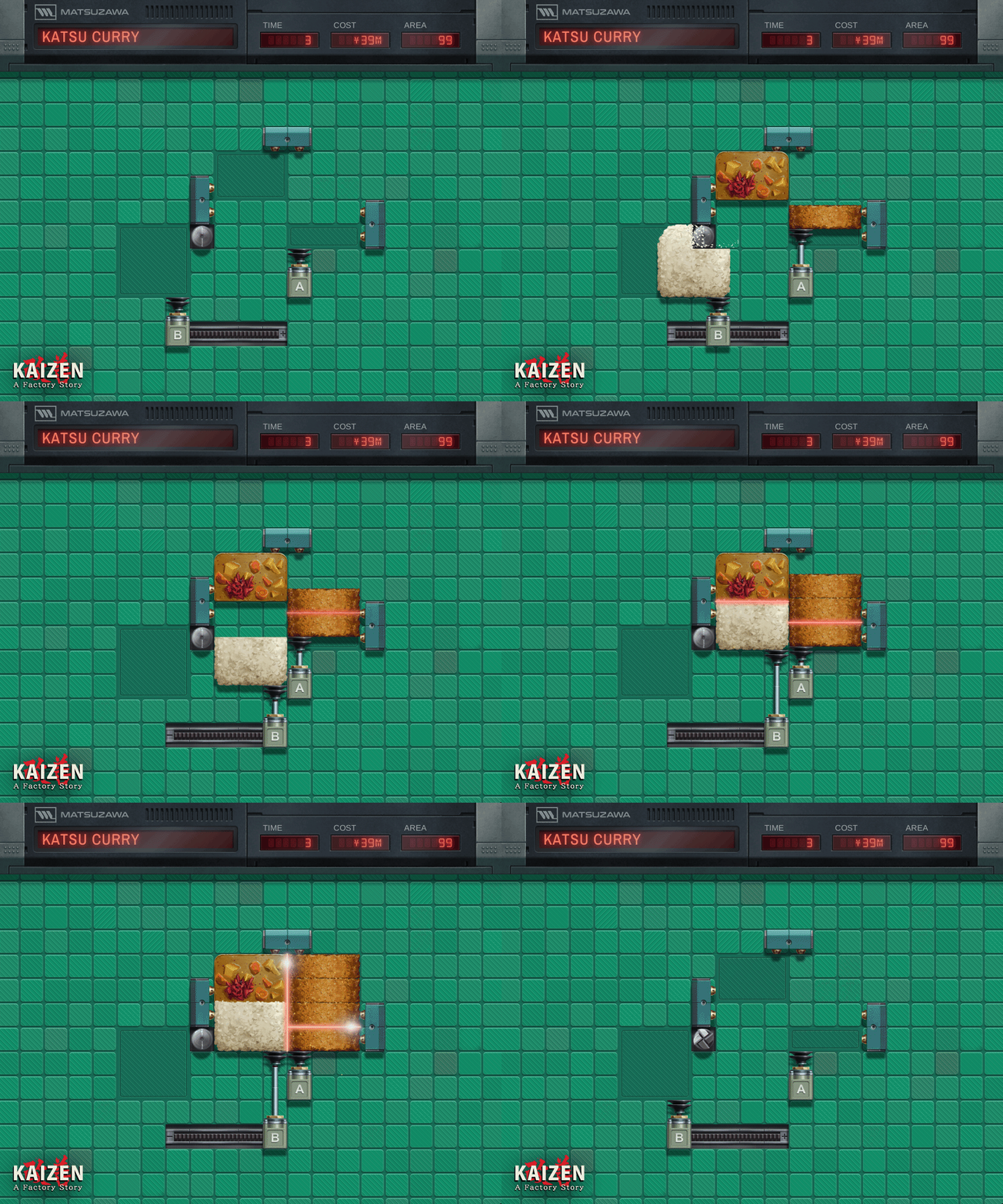
The tools are simple but, like the best Zachtronics games, they're just a foundation -- progressively-harder scenarios will teach you to combine them for novel and practical functions, like flipping a part onto a cutter to remove interior pieces. Programming is simple too, by dragging and dropping instructions onto a program timeline; it even supports step-by-step backward and forward scrubbing, which is a relief compared to De Re Metallica's painful debugging.
Every puzzle has some fresh new twist to it, and most of them strike a pleasant balance between figuring out how to manipulate parts correctly, and how to avoid collisions in the implementation. Although later puzzles can - like Opus Magnum's - feel frustratingly fiddly due to how many components are in play at once. And the visual timeline becomes annoying to navigate in lengthy programs.
So I'm not super-interested in attempting the post-game bonus puzzles, which get even more complex. But I overall enjoyed the main story's automation challenges.
Kaizen's puzzles are fun, its dialog is fun, and its presentation is fun. It's ... fun!
Better than: Last Call BBS, Shenzhen I/O
Not as good as: Exapunks
I actually enjoyed: the first Pachi-Sol (pachinko solitaire) level, but later variants with hidden cards that only appear temporarily can fuck right off.